Over here in Fiji everything's chugging along with the end of Pre-Service Training. Thankfully I passed my Language Proficiency Exam with flying colors, so now as planned I will "swear in" as a Peace Corps Volunteer on Thursday of this week, and my 24-months of service as a Community Health Promotion Volunteer will officially begin.
THE END OF TRAINING
The Peace Corps Staff picked up all of my luggage from the host family house this morning in order to store it all at the office in Suva, the capital city, in preparation for my traveling. And today is the last official day of training. Tomorrow I'm taking the early bus to Suva (the capital city) so I can buy some of my necessities (like a mattress and a kerosene stove) that will not be provided by my village once I move to site. I also plan do a run to the only supermarket/ superstore in Fiji that carries imported international products (like mustard, antibacterial dish soap, dried fruit and nuts, protein powder, and Nutella) before I truly drop off the grid here.
Tomorrow evening my host village is having a community celebration for us trainees who have lived there over the past nine weeks. They've been preparing traditional entertainment for us (like a dance called the "Meke") all week long, and today the men are hard at work building a "Lovo" (underground, pit-style, oven) for the massive dinner feast they're going to have for the entire village tomorrow night in the Community Hall. Because the village has almost a thousand residents (it's a HUGE village by Fijian standards... my new one will have less than 120 people, and only 12 houses, to put that into perspective), the affair promises to be a good time.
I promise to upload some pictures of this, and other similar events of the past few weeks, as soon as possible. It may be a while, though.
SWEARING IN / MOVING TO SITE
Then, Thursday we're officially "swearing in" as Peace Corps Volunteers at the U.S. Ambassador's house in front of 200 diplomatic guests and the Fijian media (if you care to, maybe you'll be able to find a clip or two on YouTube). And on Friday, my overnight boat to Vanua Levu departs.
When all is said and done, I will arrive in my village (to a house I've heard is 99.9% finished by now!!) to start my new life there on Saturday afternoon. So, wish me luck!
MAIL/COMMUNICATIONS
From now on the address noted below is the best way to get mail to me. So, this means that I can now start receiving fun things for my new house if the mood strikes you to send something.
Melissa Goldman
P.O Box 824
Savusavu, Fiji Islands
South Pacific
[Just a note: I've learned that flat-rate international boxes are--by far!--the cheapest method for sending heavy/bulky items (like food :-) ). I think the smallest one (which a friend already discovered can fit as much as a bottle of chalua hot sauce, a package of dried fruit, three packs of almonds and like 6 lolli pops)costs less than $15 to ship to Fiji.]
I dont want to seem presumptuous here, but a few people have asked me what I would like to receive. So, if you're looking for ideas of things to send, basically anything that reminds me of home will be heartily welcomed. For example, stickers and cards would be nice to put up on my walls. I would also always love to receive necessities like hand sanitizer and zip lock baggies, entertainment like magazines and the front page/comics page of the newspaper, and food/snacks like granola, candy (i.e. candy corn, jelli beans, lolli pops, and any sort of milk chocolate treats), energy bars, and teas.
Also, please note that as soon as I move to site my communication capabilities will be seriously limited compared to how they've been during training. I will only be making the 5-hour round-trip bus trek into the nearest town for groceries approximately once a week. I can only hope tto have enough time to visit the post office and the internet cafe on these busy days. There are no guarantees.
Additionally, I will be getting a new Fijian cell phone in the next week due to coverage issues by my current carrier, so I will be sure to let you all know that information as soon as it becomes available.
THE MONTHS TO COME
All in all, I am very excited to get started with my "real" Peace Corps experience.
The first two-months at site are going to be "learning-only," as determined by the Peace Corps. They do not want us to start any new projects during this time, but instead we are supposed to focus on integrating into the community and learning the language (which is a new dialect compared to the one I've been studying so far) more fully.
Then, after a short training conference in early October, the work will start.
Like I mentioned earlier, I am a Community Health Promotion Volunteer. Luckily, because I am going to be placed in a small village, this really will mean whatever myself and the community decide. I will basically be there to act as a skills-transfer resource rather than a money-providing one. So, I will be able to provide trainings in areas like dental hygiene, nutrition, safe sex practices and the like. I'll also be available as a resource to help existing groups develop their ideas for community initiatives, and I will also be able to assist my community in accessing funding for projects in which it proves necessary to do so (via grant-writing workshops, etc).
The biggest goal of the next two years is to accomplish as much as possible in a sustainable way. That means, when I leave the community should be able to continue all the work that we've done. I know this is a huge task. The work will be slow-going and frustrating at times, but I welcome the challenge. I'm ready to get started.
Please everyone, send positive thoughts my way.
I love and miss you all.
xoxo
Melissa
Monday, July 20, 2009

Tuesday, June 30, 2009
3 Weeks and Counting…
Hi everybody!
I just got back from a 6-day trip visiting my future Fijian village, and it was absolutely incredible! I took a million pictures, and I will be sure to upload them as soon as I can.
TRAVELING TO VANUA LEVU
So my village is located on Vanua Levu, the second-largest island in Fiji. To get there, I took a 14-hour, overnight boat ride from Suva, the capital city, to Savusavu, the smaller of the only two towns on Vanua Levu. The boat ride to Vanua Levu, which apparently is usually quite pleasant with relatively-clean sleeper bunks located in the “first class cabin” where Peace Corps put us up for this trip, was unfortunately a VERY unpleasant experience. There were 28-not winds, which (according to a ex-merchant-marine in my training class) is considered “unsafe seas” and is 2-nots from international regulations deeming the seas impassable. So, as you can probably imagine, most of my traveling companions and I spent a long and miserable evening on the boat decks, losing our dinners over the side.
THE TOWN
Savusavu, however, is a beautiful little town. It’s a very touristy/yachty place with a picturesque harbor. It mainly consists of one small road with an open-air produce market, several tourist-type shops, a two-part grocery store, a couple little hardware stores and home-goods stores, a bakery, a small breadshop, and several little restaurant/bars. There are currently two Peace Corps volunteers who live in a little house up on the hill above town (with views of the harbor from their veranda), and when they leave in August, a girl from my training class will take over their place. For the next two years, this will be my “re-stocking” town, and this little house will be my Savusavu hub.

A view of the coconut trees lining the road from Savusavu to my village.

Ocean views out the bus window.

Lush, vine-covered landscape surrounding my village.
MY VILLAGE
From Savusavu, my village is a 2 hour, 30 minute bus ride away. The scenery along the mostly-dirt road is pretty amazing. It winds along the Southestern peninsula that juts out from Vanua Levu, and most of the way there are views of turquoise and cobalt blue waters with a white-sand-beach coastline fringed in coconut trees. My village is located on the beach-side of this road, and therefore overlooks one of these beautiful beaches. Many of the homes even have views of the ocean, and the first day I was there (which was a Saturday), some of the local children and I went for a dip in the ocean approximately 50 paces from my future house.

The view from our little beach.

This is where the village children and I went for our dip at low tide.
The village is pretty small. It consists of 12 houses and about 100 people. Each house is pretty big and is home to about one extended family each. The village is pretty clean (in terms of rubbish), and each house has a giant phone-pole looking thing with two solar panels on top to power a single lightbulb inside. There’s not quite enough electricity to have electrical plugs inside the home, so nobody has a refrigerator or a fan (although one house does have a little generator and a television where the kids watch movies at night). Surrounding the houses are lots of pretty flower plants (including some Frangipani trees), plenty of Coconut, Mango, Vundi (like Plantains), and Breadfruit (taste like potatoes when they’re unripe like now, and I haven’t tried them ripe yet) trees. I will even have my own breadfruit and Vundi trees to myself, and I plan to also plant a little vegetable garden next to my house.

This is the church as viewed across the "street" from my little house.
My house is a tiny little wooden house that apparently has been a radio broadcasting center, a village store, and a health supplies dispensary. Right now, it’s essentially a house frame that lies directly across from the village church, and it currently serves as a hang out for the village men after services get out (the ladies congregate on the benches outside the church entrance). They swear to me up and down that the house will be finished before I move there in three weeks, but if it’s not then I will stay with a host family (probably in the chief’s house where I was over the weekend) until it’s ready. Please cross your fingers for me that it gets done—I could really use some private space!

This is my house so far. The phone pole looking thing has two small solar panels on top and is wired to the house. The children and I are standing on the "veranda." As you can see, most of the outside walls are finished, but we're still waiting on the bathroom/shower attachment and the bedroom walls to be finished, among other construction.
THE VILLAGERS
The people in my village are the main reason that I’m so looking forward to moving there. Like I wrote before, the entire village belongs to one Mataqali (family clan), which means that they’re all extremely close. The ladies in the village are known for their weaving, and there are three different types of weaving materials that they grow in the village to make all different types of mats. It looks like incredibly intricate and time consuming work (especially since the women also cook and clean and do all the hand-washing and raise the children), but I’m very excited for them to teach me how to do it! All the men are farmers, and many fish and catch crabs and prawns as well.

My community counterpart (Sereana, the wife of the chief's eldest son) weaving a mat from "Voivoi" reeds inside the chief's living room.
THE YOUTH
There is also an established (church-based) youth group in the village. This consists of 14 individuals (10 boys and 4 girls… 5 now if you count me!) between the ages of 18 and 30. Every Monday night they have a church night to themselves and then they have tea and snacks before an all-night grog session afterwards. On the last Monday of every month, the youth from a neighboring village come together with mine for a joint church/tea/grog session, so I got to participate in that on my last evening there. The great news about this is that there are at least some girls in the village around my age (which is usually not the case in Fijian villages… they either get married and leave the village or they go and school or work in one of the towns or cities—meaning that most villages have a female populations of young girls and then older women who are mothers and grandmothers). Two of the youth girls are married, and two are not, but they are all between the ages of 19 and 26. One of the married girls (who doesn’t have kids yet), married into the village and happens not to be Methodist (she’s Catholic), so that could be really great for me to have a friend who’s not quite as passionate about all the religious fervor.

Me and some of the ladies at a farewell kava session. I'm wearing a lei of Frangiapani flowers that they made for me, and we're all wearing the flowers behind our ears.
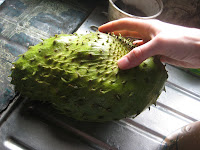
A crazy-looking fruit that we made fresh jam from on my last night. I forget what it's called, but it has white flesh, a few black seeds, and is absolutely delicious! The jam tastes and looks sort of like honey, and I'm certain that I've already gained like 5 pounds from the jar they gave me to take back to my host village.

Lusi, the chief's eldest daughter, with one of her Fijian-style pies to sell at the bus stand.
WHAT LIES AHEAD…
So, like I said before, I had a great time this weekend! I went swimming and collected seashells with the children, I walked along the sandy beaches to the local primary school and explored the settlements along the way. I watched the women make mats and bake pies, we made jam, and we had several lengthy, all-night, kava sessions (family, village ladies, youth, and a farewell youth/ladies session for me on the last night). All in all, I am ecstatic about moving to my site. I can’t wait to upload pictures so you can all see it!

A view of the pre-school building at the local school.
Please be advised that I now have a new mailing address:
Melissa Goldman
P.O. Box 824
Savusavu, Fiji Islands
South Pacific
I will be moving permanently in three-weeks time, and from there on out I will be checking my mail/email approximately once every two weeks. I greatly enjoy hearing from you all, and I hope that you’re all liking my blog so far. Please let me know if you have any suggestions of topics you would like me to cover in my future posts. Otherwise, I’ll just keep doing what I’ve been doing.
Thanks for all of your support. I miss you all!
Melissa
I just got back from a 6-day trip visiting my future Fijian village, and it was absolutely incredible! I took a million pictures, and I will be sure to upload them as soon as I can.
TRAVELING TO VANUA LEVU
So my village is located on Vanua Levu, the second-largest island in Fiji. To get there, I took a 14-hour, overnight boat ride from Suva, the capital city, to Savusavu, the smaller of the only two towns on Vanua Levu. The boat ride to Vanua Levu, which apparently is usually quite pleasant with relatively-clean sleeper bunks located in the “first class cabin” where Peace Corps put us up for this trip, was unfortunately a VERY unpleasant experience. There were 28-not winds, which (according to a ex-merchant-marine in my training class) is considered “unsafe seas” and is 2-nots from international regulations deeming the seas impassable. So, as you can probably imagine, most of my traveling companions and I spent a long and miserable evening on the boat decks, losing our dinners over the side.
THE TOWN
Savusavu, however, is a beautiful little town. It’s a very touristy/yachty place with a picturesque harbor. It mainly consists of one small road with an open-air produce market, several tourist-type shops, a two-part grocery store, a couple little hardware stores and home-goods stores, a bakery, a small breadshop, and several little restaurant/bars. There are currently two Peace Corps volunteers who live in a little house up on the hill above town (with views of the harbor from their veranda), and when they leave in August, a girl from my training class will take over their place. For the next two years, this will be my “re-stocking” town, and this little house will be my Savusavu hub.

A view of the coconut trees lining the road from Savusavu to my village.

Ocean views out the bus window.

Lush, vine-covered landscape surrounding my village.
MY VILLAGE
From Savusavu, my village is a 2 hour, 30 minute bus ride away. The scenery along the mostly-dirt road is pretty amazing. It winds along the Southestern peninsula that juts out from Vanua Levu, and most of the way there are views of turquoise and cobalt blue waters with a white-sand-beach coastline fringed in coconut trees. My village is located on the beach-side of this road, and therefore overlooks one of these beautiful beaches. Many of the homes even have views of the ocean, and the first day I was there (which was a Saturday), some of the local children and I went for a dip in the ocean approximately 50 paces from my future house.

The view from our little beach.

This is where the village children and I went for our dip at low tide.
The village is pretty small. It consists of 12 houses and about 100 people. Each house is pretty big and is home to about one extended family each. The village is pretty clean (in terms of rubbish), and each house has a giant phone-pole looking thing with two solar panels on top to power a single lightbulb inside. There’s not quite enough electricity to have electrical plugs inside the home, so nobody has a refrigerator or a fan (although one house does have a little generator and a television where the kids watch movies at night). Surrounding the houses are lots of pretty flower plants (including some Frangipani trees), plenty of Coconut, Mango, Vundi (like Plantains), and Breadfruit (taste like potatoes when they’re unripe like now, and I haven’t tried them ripe yet) trees. I will even have my own breadfruit and Vundi trees to myself, and I plan to also plant a little vegetable garden next to my house.

This is the church as viewed across the "street" from my little house.
My house is a tiny little wooden house that apparently has been a radio broadcasting center, a village store, and a health supplies dispensary. Right now, it’s essentially a house frame that lies directly across from the village church, and it currently serves as a hang out for the village men after services get out (the ladies congregate on the benches outside the church entrance). They swear to me up and down that the house will be finished before I move there in three weeks, but if it’s not then I will stay with a host family (probably in the chief’s house where I was over the weekend) until it’s ready. Please cross your fingers for me that it gets done—I could really use some private space!

This is my house so far. The phone pole looking thing has two small solar panels on top and is wired to the house. The children and I are standing on the "veranda." As you can see, most of the outside walls are finished, but we're still waiting on the bathroom/shower attachment and the bedroom walls to be finished, among other construction.
THE VILLAGERS
The people in my village are the main reason that I’m so looking forward to moving there. Like I wrote before, the entire village belongs to one Mataqali (family clan), which means that they’re all extremely close. The ladies in the village are known for their weaving, and there are three different types of weaving materials that they grow in the village to make all different types of mats. It looks like incredibly intricate and time consuming work (especially since the women also cook and clean and do all the hand-washing and raise the children), but I’m very excited for them to teach me how to do it! All the men are farmers, and many fish and catch crabs and prawns as well.

My community counterpart (Sereana, the wife of the chief's eldest son) weaving a mat from "Voivoi" reeds inside the chief's living room.
THE YOUTH
There is also an established (church-based) youth group in the village. This consists of 14 individuals (10 boys and 4 girls… 5 now if you count me!) between the ages of 18 and 30. Every Monday night they have a church night to themselves and then they have tea and snacks before an all-night grog session afterwards. On the last Monday of every month, the youth from a neighboring village come together with mine for a joint church/tea/grog session, so I got to participate in that on my last evening there. The great news about this is that there are at least some girls in the village around my age (which is usually not the case in Fijian villages… they either get married and leave the village or they go and school or work in one of the towns or cities—meaning that most villages have a female populations of young girls and then older women who are mothers and grandmothers). Two of the youth girls are married, and two are not, but they are all between the ages of 19 and 26. One of the married girls (who doesn’t have kids yet), married into the village and happens not to be Methodist (she’s Catholic), so that could be really great for me to have a friend who’s not quite as passionate about all the religious fervor.

Me and some of the ladies at a farewell kava session. I'm wearing a lei of Frangiapani flowers that they made for me, and we're all wearing the flowers behind our ears.

A crazy-looking fruit that we made fresh jam from on my last night. I forget what it's called, but it has white flesh, a few black seeds, and is absolutely delicious! The jam tastes and looks sort of like honey, and I'm certain that I've already gained like 5 pounds from the jar they gave me to take back to my host village.

Lusi, the chief's eldest daughter, with one of her Fijian-style pies to sell at the bus stand.
WHAT LIES AHEAD…
So, like I said before, I had a great time this weekend! I went swimming and collected seashells with the children, I walked along the sandy beaches to the local primary school and explored the settlements along the way. I watched the women make mats and bake pies, we made jam, and we had several lengthy, all-night, kava sessions (family, village ladies, youth, and a farewell youth/ladies session for me on the last night). All in all, I am ecstatic about moving to my site. I can’t wait to upload pictures so you can all see it!

A view of the pre-school building at the local school.
Please be advised that I now have a new mailing address:
Melissa Goldman
P.O. Box 824
Savusavu, Fiji Islands
South Pacific
I will be moving permanently in three-weeks time, and from there on out I will be checking my mail/email approximately once every two weeks. I greatly enjoy hearing from you all, and I hope that you’re all liking my blog so far. Please let me know if you have any suggestions of topics you would like me to cover in my future posts. Otherwise, I’ll just keep doing what I’ve been doing.
Thanks for all of your support. I miss you all!
Melissa
Friday, June 19, 2009
Vanua Levu, Here I Come!
We just found out where our two-year sites are going to be, and I’m both excited and nervous. I can’t post the name of my specific village on this blog, but I can tell you that it’s on the Southeast coast of Vanua Levu, the second-largest island in Fiji, just North of Viti Levu.
The village is approximately two-hours by bus from Savusavu, a medium-sized town with a supermarket, some internet access, a post office and a bank (none of these will be available closer for me). My site is a small fishing community with approximately 131 people (25 families--all of the same clan, which should be interesting in terms of the “coconut wireless” [aka the gossip]), and my initial contact person is the village nurse (I’m very happy to hear that we have one!).
My house is the old “radio tower,” which means it’s a wooden house up on a hill right in the middle of everything. Apparently, the site almost always has running water… and it’s powered by solar, rooftop panels (I’m not sure what this means for the rainy season…). On their last visit, the Peace Corps even requested that my village build a veranda onto my house, and I will have an indoor shower and toilet! I’m also very happy to hear that my closest neighbors (literally a stone’s throw away) are the Turaga (the highly-respected village Chief), and the Turaganikoro (the Mayor-type guy and who makes and enforces all village policies). This means that I should be pretty safe--and that’s a huge relief!
The job description I’ve received with my information packet is pretty vague. But essentially it sounds like I’ll be working on three main projects:
- Sexual health and gender issue stuff with the village youth group.
- Upgrading village sanitation and establishing a “Healthy Village Setting” (which is the project I’m working on in my host family village and which I will write about in my next blog entry).
- Expanding the women’s group existing small business project (selling pies and other baked goods roadside to passing buses).
Initially, I’m slightly concerned that I’ll be two hours from the nearest amenities and it sounds likely I won’t have cell phone service in my village. Also, there are only seven people from my training class on Vanua Levu (19 are on Viti Levu) and I’m pretty far away from most of them, so the isolation piece of it is a little daunting. However, I am the closest Peace Corps Volunteer in my training class to Taveuni Island, which is the prime destination point in Fiji (!), and Savusavu is a “tourist town” with an airport (only $100 FD to fly there from Suva or Nadi according to my source) which makes it less than an hour from Viti Levu (if you travel by boat it’s usually 14 hours+).
Next weekend I will meet my initial contact person for a two-day conference and then she and I will travel to the village for a long weekend visit. I will be sure to post pictures and stories from that trip as soon as they are available.
For now, my site is basically just a piece of paper. But it already seems pretty real. This is my life for the next two years, you guys. Wish me luck!
Moce Vakalailai
Melissa

The village is approximately two-hours by bus from Savusavu, a medium-sized town with a supermarket, some internet access, a post office and a bank (none of these will be available closer for me). My site is a small fishing community with approximately 131 people (25 families--all of the same clan, which should be interesting in terms of the “coconut wireless” [aka the gossip]), and my initial contact person is the village nurse (I’m very happy to hear that we have one!).
My house is the old “radio tower,” which means it’s a wooden house up on a hill right in the middle of everything. Apparently, the site almost always has running water… and it’s powered by solar, rooftop panels (I’m not sure what this means for the rainy season…). On their last visit, the Peace Corps even requested that my village build a veranda onto my house, and I will have an indoor shower and toilet! I’m also very happy to hear that my closest neighbors (literally a stone’s throw away) are the Turaga (the highly-respected village Chief), and the Turaganikoro (the Mayor-type guy and who makes and enforces all village policies). This means that I should be pretty safe--and that’s a huge relief!
The job description I’ve received with my information packet is pretty vague. But essentially it sounds like I’ll be working on three main projects:
- Sexual health and gender issue stuff with the village youth group.
- Upgrading village sanitation and establishing a “Healthy Village Setting” (which is the project I’m working on in my host family village and which I will write about in my next blog entry).
- Expanding the women’s group existing small business project (selling pies and other baked goods roadside to passing buses).
Initially, I’m slightly concerned that I’ll be two hours from the nearest amenities and it sounds likely I won’t have cell phone service in my village. Also, there are only seven people from my training class on Vanua Levu (19 are on Viti Levu) and I’m pretty far away from most of them, so the isolation piece of it is a little daunting. However, I am the closest Peace Corps Volunteer in my training class to Taveuni Island, which is the prime destination point in Fiji (!), and Savusavu is a “tourist town” with an airport (only $100 FD to fly there from Suva or Nadi according to my source) which makes it less than an hour from Viti Levu (if you travel by boat it’s usually 14 hours+).
Next weekend I will meet my initial contact person for a two-day conference and then she and I will travel to the village for a long weekend visit. I will be sure to post pictures and stories from that trip as soon as they are available.
For now, my site is basically just a piece of paper. But it already seems pretty real. This is my life for the next two years, you guys. Wish me luck!
Moce Vakalailai
Melissa

Tuesday, June 16, 2009
Swimming, Snorkeling, and Fresh Jamu
Swimming, Snorkeling, and Fresh Jamu
Sorry it’s been so long since my last post, but I’ve had a whirlwind couple of weeks!
Last weekend all of the Peace Corps Trainees in my training class got to visit currently serving volunteers at their sites for a long weekend. I was sent to a site in the Ra region (of Northern Viti Levu). A volunteer named Natalie has been living in a small, offshore village there for a little over a year now. Her site is accessible only by boat (the roads were washed out by years of rainy seasons), and the boat usually only runs once a week on the village’s “market day” when many of the villagers come into the nearest town, Rakiraki, to buy some food and supplies.
Natalie lives in a Bure, which is a traditional-style Fijian home. It is constructed by the village using all natural materials that can be found in the area. The walls are basically woven and the roof is thatched with palm fronds. The floor is my favorite part. It’s a coral sand floor with palm fronds covered by Pandena Mats (which are these intricate mats woven by Fijian women that take weeks of labor to complete). In fact, the floor is so springy and soft that Natalie says she often sleeps directly on it when the weather is particularly hot. Her Bure doesn’t have electricity, which usually isn’t a problem due to the openness of the structure. Unfortunately she doesn’t have a refrigerator and so can almost never get anything like cheese, yogurt or ice cream (she cooks on a portable, kerosene stovetop), but at least there’s a generator that runs for three hours every night so she has a small window of artificial light and a chance to recharge things like her phone, her ipod, and her batteries.
Over the weekend, the three of us visitors and Natalie had some adventures that really convinced me that I want a site just like hers – and I told that to the Peace Corps placement staff yesterday when I had my final placement interview. On Sunday instead of church (which ended up causing a bit of a stir in her village because we skipped it), the four of us trekked like 2 hours through the forest/jungle and along the mangrove-trodden coast to get to a little beach and snorkeling site right in front of the area’s primary school. The children from the four surrounding villages board at the school there because it’s so difficult to get to, and every day a different mother is responsible for going and cooking for all the children. Anyway, it was amazing just to be able to jump in the water, swim 15 minutes over the deep blue, and find a relatively healthy reef… It was a little weird to snorkel in T-shirts, knee-length shorts, and the water-shoes we needed to walk out to the drop off, though…
On Monday we went with some of Natalie’s Fijian friends into the woods right by the village, climbed some “raspberry” trees (more like cherries if you ask me), collected berries, and made from jam (“Jamu,” pronounced ‘ch-ah-moo’) from scratch! It was so easy to make, too. Natalie says she does it all year long and makes jam from basically whatever fruit is in season. We got so excited about the Jamu that we collected way too many berries. In the end, we had to go Kerekere some jars from other village-members, including the chief’s wife. When we were finished making it, we gorged on Peanut Butter and Jelly sandwiches that were absolutely divine! Somehow, whenever I’m away from home, all I need is some good old PBJ to keep me happy!
Anyway, after all that excitement it was nice to come "home" to my host family this last week. We also just started our health promoting project in the host village which is very exciting. I wish I had more time to talk about it but I have to run!
This weekend (on Saturday afternoon), we will find out our 2-year site locations and job descriptions, so you can all expect a post from me shortly thereafter. Also, I'll do my best to get some more pictures on the blog. Please bear with me--this internet is so slow!


Thanks for all the moral support everyone. I miss you all!
Moce Vakalailai
Melissa
Sorry it’s been so long since my last post, but I’ve had a whirlwind couple of weeks!
Last weekend all of the Peace Corps Trainees in my training class got to visit currently serving volunteers at their sites for a long weekend. I was sent to a site in the Ra region (of Northern Viti Levu). A volunteer named Natalie has been living in a small, offshore village there for a little over a year now. Her site is accessible only by boat (the roads were washed out by years of rainy seasons), and the boat usually only runs once a week on the village’s “market day” when many of the villagers come into the nearest town, Rakiraki, to buy some food and supplies.
Natalie lives in a Bure, which is a traditional-style Fijian home. It is constructed by the village using all natural materials that can be found in the area. The walls are basically woven and the roof is thatched with palm fronds. The floor is my favorite part. It’s a coral sand floor with palm fronds covered by Pandena Mats (which are these intricate mats woven by Fijian women that take weeks of labor to complete). In fact, the floor is so springy and soft that Natalie says she often sleeps directly on it when the weather is particularly hot. Her Bure doesn’t have electricity, which usually isn’t a problem due to the openness of the structure. Unfortunately she doesn’t have a refrigerator and so can almost never get anything like cheese, yogurt or ice cream (she cooks on a portable, kerosene stovetop), but at least there’s a generator that runs for three hours every night so she has a small window of artificial light and a chance to recharge things like her phone, her ipod, and her batteries.
Over the weekend, the three of us visitors and Natalie had some adventures that really convinced me that I want a site just like hers – and I told that to the Peace Corps placement staff yesterday when I had my final placement interview. On Sunday instead of church (which ended up causing a bit of a stir in her village because we skipped it), the four of us trekked like 2 hours through the forest/jungle and along the mangrove-trodden coast to get to a little beach and snorkeling site right in front of the area’s primary school. The children from the four surrounding villages board at the school there because it’s so difficult to get to, and every day a different mother is responsible for going and cooking for all the children. Anyway, it was amazing just to be able to jump in the water, swim 15 minutes over the deep blue, and find a relatively healthy reef… It was a little weird to snorkel in T-shirts, knee-length shorts, and the water-shoes we needed to walk out to the drop off, though…
On Monday we went with some of Natalie’s Fijian friends into the woods right by the village, climbed some “raspberry” trees (more like cherries if you ask me), collected berries, and made from jam (“Jamu,” pronounced ‘ch-ah-moo’) from scratch! It was so easy to make, too. Natalie says she does it all year long and makes jam from basically whatever fruit is in season. We got so excited about the Jamu that we collected way too many berries. In the end, we had to go Kerekere some jars from other village-members, including the chief’s wife. When we were finished making it, we gorged on Peanut Butter and Jelly sandwiches that were absolutely divine! Somehow, whenever I’m away from home, all I need is some good old PBJ to keep me happy!
Anyway, after all that excitement it was nice to come "home" to my host family this last week. We also just started our health promoting project in the host village which is very exciting. I wish I had more time to talk about it but I have to run!
This weekend (on Saturday afternoon), we will find out our 2-year site locations and job descriptions, so you can all expect a post from me shortly thereafter. Also, I'll do my best to get some more pictures on the blog. Please bear with me--this internet is so slow!


Thanks for all the moral support everyone. I miss you all!
Moce Vakalailai
Melissa
Friday, June 5, 2009
Kana Vakalevu


(Kana Vakalevu translates to, “eat more!” So far, this is the most universal piece of communication between peace corps trainees and their host mothers. The appropriate response is , “Sega Vinaka. Au sa Mamau, which translates to, “no thanks, I’m full.”)
FIJIAN VILLAGE CUSTOMS:
Well, week two of my host family village stay is coming to a close, and so far everything is still going great. I’m finally getting accustomed to some of the most important cultural differences here, such as:
- Respecting the head and shoulder areas because they are sacred. This means no sunglasses, no hats, no bandanas, and no carrying objects/bags on shoulders or heads in the villages. Also, this means that any time one wants to walk past a Fijian person who is sitting, one must utter the word, “Tulou.”
- Always covering up the body. I have seen virtually no Fijian shoulders or knees since I’ve been here in-country so far, and I guess that is for several reasons. Not only are Fijians fairly modest people who also don’t wear low-cut , shear, or tight-fitting clothing, but they also sit on the floor almost constantly. This means, that unless the skirt/dress is flowing and WELL below the knees (usually ankle length is best), then it’s easy to flash someone sitting across from you. And that’s never good. Also, the mosquitoes here are vicious, so the more skin that’s covered, the better!
- On that note, another major cultural  difference that is taking some getting used to is simply sitting on the floor with the knees tucked to the side all the time. At first, my legs fell asleep several times a day and my hips would always hurt, but I'm starting to get used to it already. Also, for the boys who are just getting used to wearing Sulus (like knee length skirts made out of nice suit-like materials) in the villages, learning to sit and shift on the floor without flashing the rest of the room is definitely a challenge we're all hoping the overcome rather quickly!
- Kerekere, which literally translates to "please" is an interesting custom here. Because Fijian people are so communal, they very literally interpret the "what's yours is mine" concept. In fact, it's not rare to tell someone you like their shirt, and a few minutes later have a shirtless Fijian standing in front of you insisting that you keep it. It also means that things like pens, lighters, and sometimes bigger items like digital cameras are pretty much up for grabs. As Peace Corps Volunteers, we try to stay out of the whole kerekere system for obvious reasons. But is is wonderful that, whenever you need something like an ingredient for a meal, all you have to do is go to a neighbor and kerekere it. They can't refuse!
- Never point at someone. Unless it’s a child, pointing at a person is considered very rude. Also, one must never point at the chief’s house or any member of his family.
- Always offer a Sevusevu when you want to accomplish anything in a village or if you want to enter it for the first time (refer to “Au Sega Ni Kila” for more information about this Kava ceremony and for a few images).
- Everything revolves around food!! When you come into your house and you’ve been away during a mealtime, the first question your family will ask you is not, “how was your day.” In fact, there is no real Fijian translation of that phrase! Instead, they will ask you, “what did you eat?” Additionally, any time you walk into someone’s house, they try to verbally bully you into staying for an impromptu meal. And if you happen to be there during a mealtime, then forget about it! You’re staying.
THE FOOD
From the title of this post you all can surely guess that food is so far playing a vital role in my host-family experience here in Fiji. Many people have been been like, and I’m happy to oblige…
First of all, most meals that I eat involve some sort of starchy root vegetable like a Cassava (“Tavioka”), a Sweet Potato (“Uvi”), or a Taro root (“Dalo”). Usually, my family makes a mixture of ketchup, chili peppers, and salt on their plates and dips the roots in it. I personally don’t think this helps much, but it seems to be their favorite food.
An interesting dish that is derived from one of these roots is called Bila, and it is a type of “bread” that is found only in this specific region of Fiji. Due to the high incidence of floods here, the Fijians found a way to use their Cassava crops that have been soaked through with water for days and days. They remove the center stalk, pound them down into a dough-like substance, mix in fresh coconut shavings and lots of cane sugar, and wrap it in a special type of leaf to cook in an underground oven (or “Lolo”) until they reach a hard, jelly-like consistency. In fact, the other day I came home from language class and my host mom was making “Vundi Tavioka.” This is Bila wrapped around Vundi (sort of like plantains), and she prepares it in order to bring the product into Suva, the capital city, and sell it in the markets—and she let me help her! It was an amazing experience, and I got to taste the final product the next morning for breakfast and I must say that I’m getting pretty good at this stuff!
My favorite dish so far, though, has to be “Ika Na Lolo Ke Roro.” Or at least I think that’s what it’s called… It’s basically a white fish (Tilapia is found in the river that runs alongside my host village) in a soup of coconut milk and Taro leaves (which are basically like spinach when cooked). Ever since I said that I like the dish, we have it almost every day.
Well, unfortunately (as usual) I have run out of time again and I must go get home so my NeNe (host mom) can show me how to make Roti and Kuri (an Indian-style meal).
Please keep sending warm wishes my way. I’ve loved getting the letters (Caitlin!) and e-mails that you all are sending, so keep them coming!
Moce Vakalailai
(“goodbye for a little”)
Melissa Lailai, a.k.a. "Adi"
(Pronounded "Ann-dee", short for "rah-nan-dee" which means Queen. This is my new Fijian name (in the host village), and is appropriate because my real Hebrew name also means Queen.)
Wednesday, May 27, 2009
Au Sega Ni Kila
("Au Sega Ni Kila" literally means "I don't understand," and so far, it's one of my most useful Fijian phrases)
Ni Sa Bula everyone!
I am writing today from Nausori again, a little town on the Southeastern side of Viti Levu, Fiji. I have finally moved in with my host family, and so far everything is going great!
MY TOWN:I am located in a village (population ~300) that is considered one of the biggest in the Bau province (it even has its own school!). It is very nice compared to where most of my fellow trainees are located. For example, there are concrete footpaths (meaning only wide enough to walk single-file) leading almost everywhere that keep us dry from the mud (it rains a lot in the tropics)! I am also very lucky to have 7 other volunteers with me in the village for company and language lessons every day.
MY HOST FAMILY: My family consists of a mother (Manaini) and a father (Eroni) who like me to call them "Nana" and "Tata." They are amazingly cute and nice, and they already tell me they will love me forever as one of their own children. They are a little bit older, and so my house is more mellow than some others who are constantly surrounded by excited young children. Luckily, all of our neighbors are extended family members and there are lots of cute kids who come and play with me but then leave to make lots of noise in their own houses at night! Although my host Mom does not speak English, most of the kids do. A three-year-old brother-cousin of mine even speaks a little, which really makes me feel great about my own language skills at this ripe old age!
MY HOUSE: Mine is a four bedroom wooden house in which I have my own bedroom with a double bed,
 a desk, a small dresser and an almost full length mirror. The outside is painted bright green and the inside is one of my favorite colors--turquoise blue. There's a small porch that my Nana and Tata like to hang out on out front as well, and yesterday Nana planted a really cute little flower garden out front. It has full-time electricity and part-time (cold) running water (they shut it off between 6pm and 5am to conserve for the region), so I really can't complain at this point
 about the amenities. There is a slight mosquito problem and I have seen a mouse or two lurking in the rafters, but that just reminds me to apply bug spray 24/7 and to get a cat when I have my own place!
Ni Sa Bula everyone!
I am writing today from Nausori again, a little town on the Southeastern side of Viti Levu, Fiji. I have finally moved in with my host family, and so far everything is going great!
MY TOWN:I am located in a village (population ~300) that is considered one of the biggest in the Bau province (it even has its own school!). It is very nice compared to where most of my fellow trainees are located. For example, there are concrete footpaths (meaning only wide enough to walk single-file) leading almost everywhere that keep us dry from the mud (it rains a lot in the tropics)! I am also very lucky to have 7 other volunteers with me in the village for company and language lessons every day.
MY HOST FAMILY:
My family consists of a mother (Manaini) and a father (Eroni) who like me to call them "Nana" and "Tata." They are amazingly cute and nice, and they already tell me they will love me forever as one of their own children. They are a little bit older, and so my house is more mellow than some others who are constantly surrounded by excited young children. Luckily, all of our neighbors are extended family members and there are lots of cute kids who come and play with me but then leave to make lots of noise in their own houses at night! Although my host Mom does not speak English, most of the kids do. A three-year-old brother-cousin of mine even speaks a little, which really makes me feel great about my own language skills at this ripe old age!MY HOUSE:
Mine is a four bedroom wooden house in which I have my own bedroom with a double bed, a desk, a small dresser and an almost full length mirror. The outside is painted bright green and the inside is one of my favorite colors--turquoise blue. There's a small porch that my Nana and Tata like to hang out on out front as well, and yesterday Nana planted a really cute little flower garden out front. It has full-time electricity and part-time (cold) running water (they shut it off between 6pm and 5am to conserve for the region), so I really can't complain at this point about the amenities. There is a slight mosquito problem and I have seen a mouse or two lurking in the rafters, but that just reminds me to apply bug spray 24/7 and to get a cat when I have my own place!MY ROUTINE
At the moment, I've got a pretty good routine going. Some of the other volunteers and I wake up in the morning to work out on the school's rugby field (this morning some of my sister-cousins who came to watch us even participated at the end), and then I have a shower and a hot breakfast with coffee before heading to language class. The afternoons are filled with lots of Peace Corps activities, but I am always home by 6pm to wash up and have a short prayer with my family before dinner. On Wednesdays, my whole training class comes into Nausori, the nearby town (with this great Internet cafe!) for some group lessons, and on Wednesday nights my whole extended family has a private prayer session for an hour followed by an evening around the Kava bowl. Sunday is a day of rest and a day for going to church, so I guess that's when I'll catch up on some sleep from my busy routine. Also, I just got a cell phone, and that's probably the best time for me to receive your calls.*
Well, it's getting late and I should go catch the bus back to my village. I'm sorry to say that once again I've run out of time to post pictures. Although, because of "kerekere" (a local custom that's almost literally like, "what's mine is yours") I haven't busted out my camera in the village yet, so you're not missing out on that much.
I miss you all dearly and I hope everything is going well at home. Please keep me in your thoughts.
xoxo
Melissa
*A note about security: Unfortunately I cannot disclose my village's name nor my cell phone number in this forum for security reasons (the "Coconut Wireless," as we call it, moves surprisingly fast), but please contact me by e-mail if you would like that information and I would be happy to provide it.
At the moment, I've got a pretty good routine going. Some of the other volunteers and I wake up in the morning to work out on the school's rugby field (this morning some of my sister-cousins who came to watch us even participated at the end), and then I have a shower and a hot breakfast with coffee before heading to language class. The afternoons are filled with lots of Peace Corps activities, but I am always home by 6pm to wash up and have a short prayer with my family before dinner. On Wednesdays, my whole training class comes into Nausori, the nearby town (with this great Internet cafe!) for some group lessons, and on Wednesday nights my whole extended family has a private prayer session for an hour followed by an evening around the Kava bowl. Sunday is a day of rest and a day for going to church, so I guess that's when I'll catch up on some sleep from my busy routine. Also, I just got a cell phone, and that's probably the best time for me to receive your calls.*
Well, it's getting late and I should go catch the bus back to my village. I'm sorry to say that once again I've run out of time to post pictures. Although, because of "kerekere" (a local custom that's almost literally like, "what's mine is yours") I haven't busted out my camera in the village yet, so you're not missing out on that much.
I miss you all dearly and I hope everything is going well at home. Please keep me in your thoughts.
xoxo
Melissa
*A note about security: Unfortunately I cannot disclose my village's name nor my cell phone number in this forum for security reasons (the "Coconut Wireless," as we call it, moves surprisingly fast), but please contact me by e-mail if you would like that information and I would be happy to provide it.
Friday, May 22, 2009
Sega Ne Lega

Sega Ne Lega (pronounced 'senga ne lenga') means 'no worries.'
Bula Vinaka everyone!
Welcome, and thank you for visiting my blog.
 It is currently my third day in-country, and everything so far is going great! After almost 40 hours of flying, my training class arrived at Nadi (prounounced 'nandi') airport on the West Coast of Viti Levu (the big island), Fiji.
  After sharing some fresh Fiji water and fruit with some of our administrative training staff and a few currently serving volunteers at the airport, we took a six-hour bus journey East to our training compound which is located in Nadave, just outside of a town called Nausori.
A few highlights of the bus trip included our first glimpse of the Fijian landscape. As you can see from the picture, EVERYTHING is green in Fiji! Even the trees are covered so thickly with green leafy vines that it's almost impossible to tell what they are!
Since then, we have been busy with various meetings and language classes to prepare us for our homestays that will begin in two days (Monday). Although I still do not yet know what village I will be placed in for the nine weeks of PST (pre-service training) (I will find out tomorrow), I do know that I will be placed in a Fijian village (as opposed to an Indo-Fijian settlement) with approximately five other Health Promotion volunteers. I am both excited and nervous to meet my host family and to get started with the meat of training!
 Right now, the training compound is somewhat like a summer camp. We are living in beautiful Bure (Fijian huts) outfitted with electricity and outhouses with (cold) showers, and we have three meals of Dalo (sliced Tarro root) and lots of Curry served daily in addition to two tea breaks. A handful of the girls and I have been waking up early to excercise in the mornings before breakfast, and although we must wear ankle length skirts during out work outs, we are having a great time. This morning we jogged under a beautiful sunrise--this truly is paradise! Hopefully, I will be able to avo id the PST-15 that all the currently serving female volunteers swear we will gain over the next few months, but somehow with all the amazing fruits and sweets, I don't see this happening.

Also a notable part of this training compound stay was the Sevusevu (Kava ceremony) that we presented to the school's managers when we first arrived. This is done in Fijian culture upon entering any new village when the goal is to accomplish some type of work. It consists of offering the Yaqona plant (which is where Kava comes from), and usually is followed by participation in a practice that I have come to informally refer to as a "Grog Session." (FYI: Kava/Yaqona/Grog is scientifically known as the "Pepper Methysticum" plant, and when the root portion is pounded into a powder-type substance, mixed with water and consumed (from half-coconut-shells), it is found to have mind-altering properties. More on that later...

Also, I've had my first experience hand-washing laundry. That was quite a feat!!

Luckily, the time change here is technically 19 hours ahead of Pacific Standard Time, but if it's easier just think of us as 5 hours earlier. That makes us 8 hours earlier than the East Coast, but it's a day ahead here, of course.
Anyway, I miss you all dearly and I hope to start receiving letters from you soon! Also, please note that packages/padded envelopes sent during my first six months of service will have duty taxes paid for by the Peace Corps, so take advantage of that now! Also, I've been told that the customs agents will asign any value they want to the items you all send, so please do your best to (under)estimate the values and include copies of any and all invoices with the goods.
Sota Tale (talk to you later)!
XOXO
Melissa Lailai
("Little Melissa")
Bula Vinaka everyone!
Welcome, and thank you for visiting my blog.
 It is currently my third day in-country, and everything so far is going great! After almost 40 hours of flying, my training class arrived at Nadi (prounounced 'nandi') airport on the West Coast of Viti Levu (the big island), Fiji.
  After sharing some fresh Fiji water and fruit with some of our administrative training staff and a few currently serving volunteers at the airport, we took a six-hour bus journey East to our training compound which is located in Nadave, just outside of a town called Nausori.
A few highlights of the bus trip included our first glimpse of the Fijian landscape. As you can see from the picture, EVERYTHING is green in Fiji! Even the trees are covered so thickly with green leafy vines that it's almost impossible to tell what they are!

Since then, we have been busy with various meetings and language classes to prepare us for our homestays that will begin in two days (Monday). Although I still do not yet know what village I will be placed in for the nine weeks of PST (pre-service training) (I will find out tomorrow), I do know that I will be placed in a Fijian village (as opposed to an Indo-Fijian settlement) with approximately five other Health Promotion volunteers. I am both excited and nervous to meet my host family and to get started with the meat of training!
 Right now, the training compound is somewhat like a summer camp. We are living in beautiful Bure (Fijian huts) outfitted with electricity and outhouses with (cold) showers, and we have three meals of Dalo (sliced Tarro root) and lots of Curry served daily in addition to two tea breaks. A handful of the girls and I have been waking up early to excercise in the mornings before breakfast, and although we must wear ankle length skirts during out work outs, we are having a great time. This morning we jogged under a beautiful sunrise--this truly is paradise! Hopefully, I will be able to avo id the PST-15 that all the currently serving female volunteers swear we will gain over the next few months, but somehow with all the amazing fruits and sweets, I don't see this happening.
Also a notable part of this training compound stay was the Sevusevu (Kava ceremony) that we presented to the school's managers when we first arrived. This is done in Fijian culture upon entering any new village when the goal is to accomplish some type of work. It consists of offering the Yaqona plant (which is where Kava comes from), and usually is followed by participation in a practice that I have come to informally refer to as a "Grog Session." (FYI: Kava/Yaqona/Grog is scientifically known as the "Pepper Methysticum" plant, and when the root portion is pounded into a powder-type substance, mixed with water and consumed (from half-coconut-shells), it is found to have mind-altering properties. More on that later...


Also, I've had my first experience hand-washing laundry. That was quite a feat!!

Luckily, the time change here is technically 19 hours ahead of Pacific Standard Time, but if it's easier just think of us as 5 hours earlier. That makes us 8 hours earlier than the East Coast, but it's a day ahead here, of course.
Anyway, I miss you all dearly and I hope to start receiving letters from you soon! Also, please note that packages/padded envelopes sent during my first six months of service will have duty taxes paid for by the Peace Corps, so take advantage of that now! Also, I've been told that the customs agents will asign any value they want to the items you all send, so please do your best to (under)estimate the values and include copies of any and all invoices with the goods.

Sota Tale (talk to you later)!
XOXO
Melissa Lailai
("Little Melissa")
Subscribe to:
Posts (Atom)
